

Once again, the Financial Crimes Enforcement Network (FinCEN) is breaking the law by failing to share the full suite of data needed to evaluate the Bank Secrecy Act. And once again, what little data it did share painted a bad picture for those who think the financial surveillance has been effective. As it stands, FinCEN’s 2026 report is nothing to celebrate.
If the Bank Secrecy Act is new to you, this set of laws and regulations requires banks and other financial institutions to report customer transactions under certain circumstances. According to FinCEN, more than 28.7 million reports were filed in fiscal year 2025 (Table 1). That’s roughly 78,000 reports a day. And the vast majority of these reports are not filed because someone is suspected of terrorism or human trafficking. Rather, it’s because they used “too much” cash.
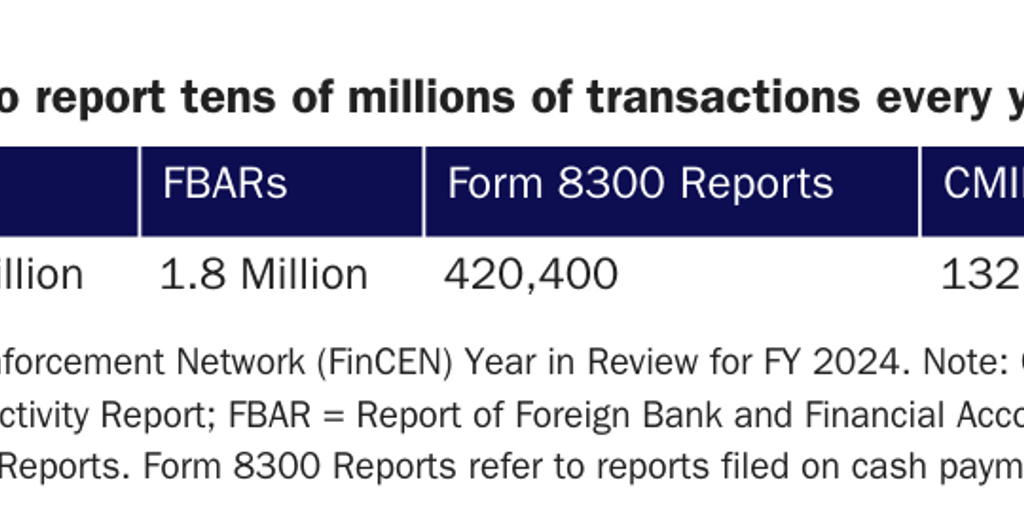
Is the Bank Secrecy Act Effective?
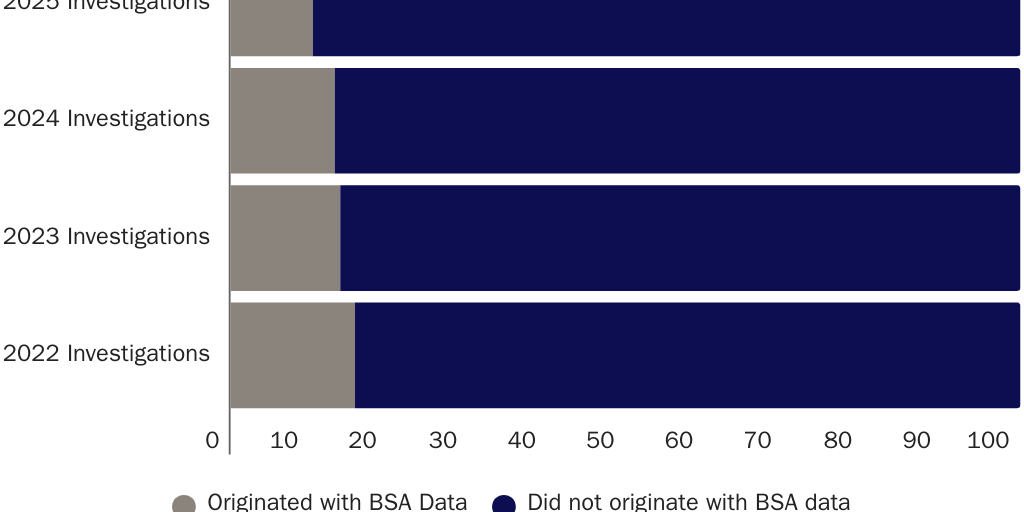
For the fourth year in a row, Bank Secrecy Act reports are less valuable than they were in the previous year (Figure 1). Only 11.7 percent of Internal Revenue Service (IRS) investigations were initiated by a suspicious activity report (9.2 percent by a currency transaction report).
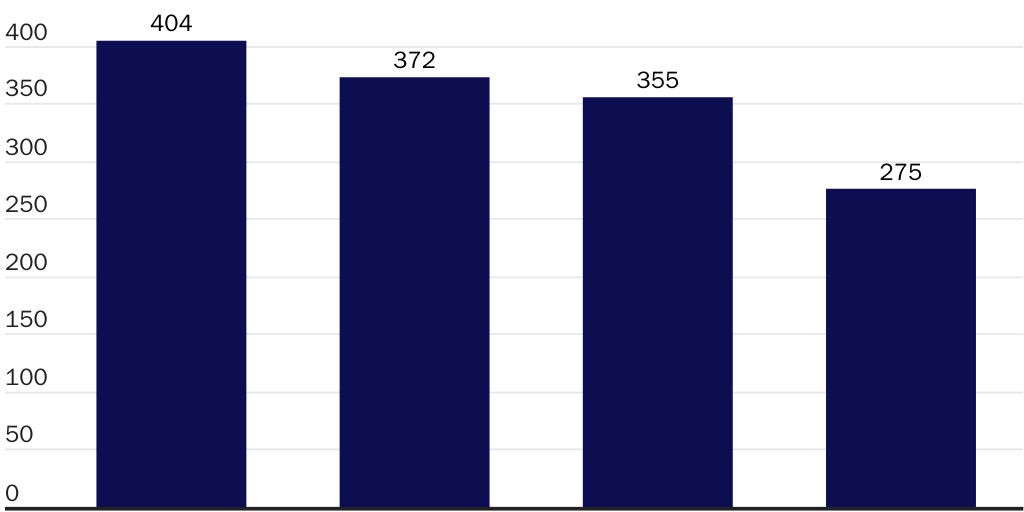
Although FinCEN failed again to provide context and only reported the percentage of investigations, we can turn to the Internal Revenue Service’s (IRS’s) Data Book series to find out just how many investigations took place because of a Bank Secrecy Act report (Figure 2). IRS data for 2025 is not yet available, but we can estimate that 2,631 investigations took place in 2025 by averaging previous years’ figures. If that’s the case, only around 275 investigations originated from a Bank Secrecy Act report.
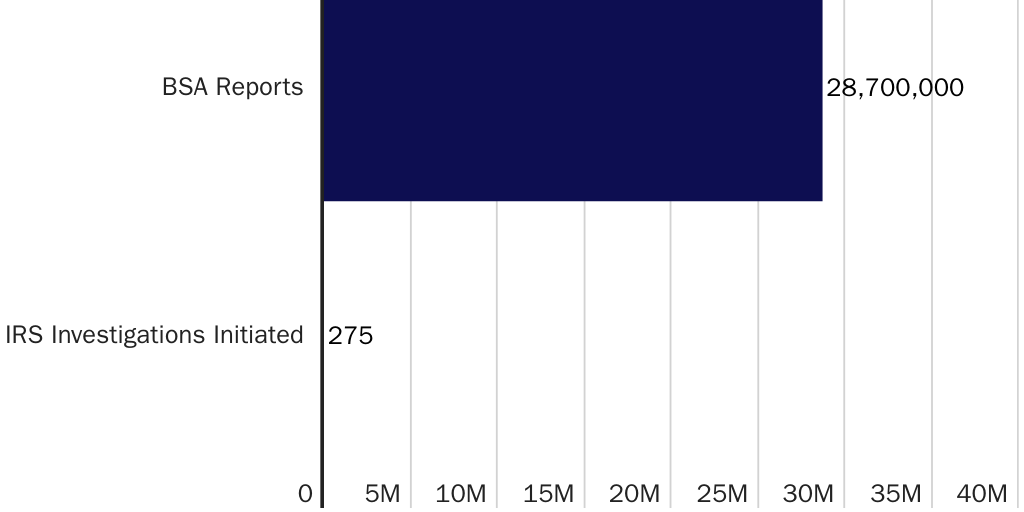
So, despite the most recent estimate that financial institutions spend $59 billion a year complying with the Bank Secrecy Act and filing more than 28.7 million reports on customers to the government, the reports initiated only around 275 criminal investigations (Figure 3).
For unknown reasons, FinCEN dropped references to Homeland Security investigations in this year’s report. However, it includes data from the Federal Bureau of Investigation (FBI). Crucially, FinCEN did not say how many FBI investigations were initiated by a Bank Secrecy Act report—either because the numbers are awful or the FBI refused to provide them. Instead, it just said that the FBI arrested 5,957 subjects “tied to [Bank Secrecy Act] Reports.”
So, let’s steelman FinCEN’s case and assume these arrests were prompted by a Bank Secrecy Act report. Even on that generous reading, 28.7 million reports possibly aiding 5,957 arrests amounts to an effective success rate of 0.02 percent.
Get a Warrant
Why is it important to distinguish between investigations initiated by a Bank Secrecy Act report and investigations that utilized one later?
The Bank Secrecy Act regime is built upon the idea that banks and other financial institutions must be forced to report their customers to the government because crime would otherwise go unnoticed. However, the numbers FinCEN provided suggest that most of the financial information that is reported is helpful only after criminal activity is noticed and law enforcement takes a closer look. If that is indeed the case, there is no reason to justify mandating that these reports be filed rather than requiring law enforcement to obtain them through the warrant process.
There is no denying that allowing law enforcement to proceed without warrants would make their jobs easier. But that is not how the system is supposed to work in this country. The founders saw firsthand how dangerous an overly aggressive government could be. Therefore, the Constitution was established to limit government power and protect the people from abuses of power. More specifically, the Fourth Amendment was enacted to protect Americans from unreasonable searches.
FinCEN Is Misrepresenting the Facts
With the data as unfavorable as it is, FinCEN took many opportunities to pad its numbers. Let’s walk through some examples.
Kicking off the report, FinCEN proclaims “Effectiveness +90%” as a success story. Yet the fine print reveals that the “90 percent” figure has nothing to do with effectiveness. It just says that 90 percent of the law enforcement officials who were surveyed said they value the data. There are two problems with this framing.
First, of course, law enforcement values more information than less. Beneficiaries of a subsidy will always report that the subsidy is beneficial. FinCEN boasts that authorized users (read: federal, state, and local law enforcement, regulatory agencies, national security agencies, and “federal partners”) searched the database of Americans’ financial records 63.9 million times last year. However, those are 63.9 million searches that should have required a warrant.
Second, this survey says nothing of substance about how these data are used. As it happens, I was just on a panel with former FinCEN Director William Fox. Fox shared how he was ecstatic when he learned the FBI used FinCEN’s data. When he asked what they used it for, they said it was a good place to get a verified name and address for a suspect. Yes, that’s right. It was about as useful as a phone book.
The next problem comes from another survey where FinCEN claims more than 85 percent of respondents said that Bank Secrecy Act reports “helped in identifying new leads,” “revealed previously unknown information,” and revealed “data used to open a new investigation or examination.” The claim here runs in direct conflict with the data showing that less than 12 percent of investigations by the Internal Revenue Service’s criminal unit are started with a report. FinCEN’s failure to address this divergence is telling.
However, the icing on the cake is that despite using these survey results as success stories, FinCEN itself admits that the data are unreliable. In a footnote on page 10, FinCEN wrote, “FinCEN survey response rates are below 80%. Low response rates and the lack of nonresponse bias analysis may impact the usefulness of the survey results.”
Stepping away from the survey, there is also a glaring omission: the costs of the Bank Secrecy Act. The agency operates on a $300 million budget, while 335,000 financial institutions spend an estimated $59 billion on complying with the regime. And that’s to say nothing of the costs incurred by people who have been debanked because of this regime. A “year in review” that reports only gross benefits is not an honest accounting.
Conclusion
FinCEN is busy telling banks how to comply with the law while it is actively breaking the law. Comprehensive reports on Bank Secrecy Act data were due five years ago. If this report is the best the agency can do, it’s time to end the Bank Secrecy Act.
