

Romina Boccia and Ivane Nachkebia

According to the annual Social Security Trustees report released yesterday, Social Security’s finances deteriorated further over the past year. Even so, the trustees are likely understating the shortfall that Congress will need to confront no later than six years from now, based on projections from Cato’s Social Security model.
The Old-Age and Survivors Insurance (OASI) Trust Fund is projected to become insolvent in 2032, a year earlier than projected in last year’s report, triggering automatic benefit cuts of 22 percent, as mandated under current law.
Compared to last year’s report, the Trustees also increased their estimate of the OASI program’s 75-year unfunded obligation—the difference between the present value of projected spending and revenues—from $26 trillion to $30 trillion. Excluding on-paper trust fund reserves, which are irrelevant from a unified budget perspective, the cash-flow shortfall is even higher, at about $33 trillion.
The scale of the problem may surprise many Americans. According to Cato’s recent Social Security survey, 76 percent of respondents believe the program is at most “moderately underfunded.” One way to appreciate the size of the funding gap is to consider what would be required to close it through higher payroll taxes alone: a 34 percent increase, raising the current 12.4 percent payroll tax rate immediately and permanently to 16.65 percent, up from last year’s projection of 16.05 percent.
For a median worker in 2026, that tax increase would amount to roughly $2,900 per year, raising the worker’s payroll tax burden from about $8,465 today to $11,365. That far exceeds what Americans say they are willing to pay: 77 percent of respondents in Cato’s survey said they would be unwilling to pay even an extra $1,300 in annual payroll taxes to fix the program.
The Trustees ascribe the worsening of the program’s finances to three primary reasons:
- The One Big Beautiful Bill Act (OBBBA) provisions, including permanently lower income tax rates and a temporarily expanded senior deduction, reduced the program’s revenues from benefit taxation.
- Lower levels of temporary and unlawful immigration as a result of restrictive border policies, meaning a smaller workforce and lower payroll tax revenues.
- Lower projected fertility rates than in last year’s report, down from an ultimate rate of 1.9 children per woman to 1.75. Because Social Security is largely financed on a pay-as-you-go basis, lower future birth rates imply a smaller future workforce paying payroll taxes and, thus, lower revenues.
Social Security’s Finances Are Likely Worse than the Trustees Project
As if these projections weren’t dire enough, the Trustees’ fertility assumptions remain more optimistic than those of the Congressional Budget Office (CBO) or the Census Bureau, suggesting that the program’s actual funding gap is understated in the report. The Trustees did lower their fertility assumptions from last year, citing continued low birth rates in the United States and abroad, as well as “societal changes related to family formation and the desire for children.” Boccia and Cato’s Krit Chanwong pointed to these trends in their critique of the assumptions in last year’s report.
That said, the Trustees still project that fertility will ultimately recover and rise above current levels. They assume that the current fertility rate of about 1.6 children per woman will rise to 1.75 by 2045 and stay at this level thereafter. By contrast, the Census Bureau projects the fertility rate will decline to 1.61 by 2045, while the CBO assumes a decline to 1.53 (Figure 1).
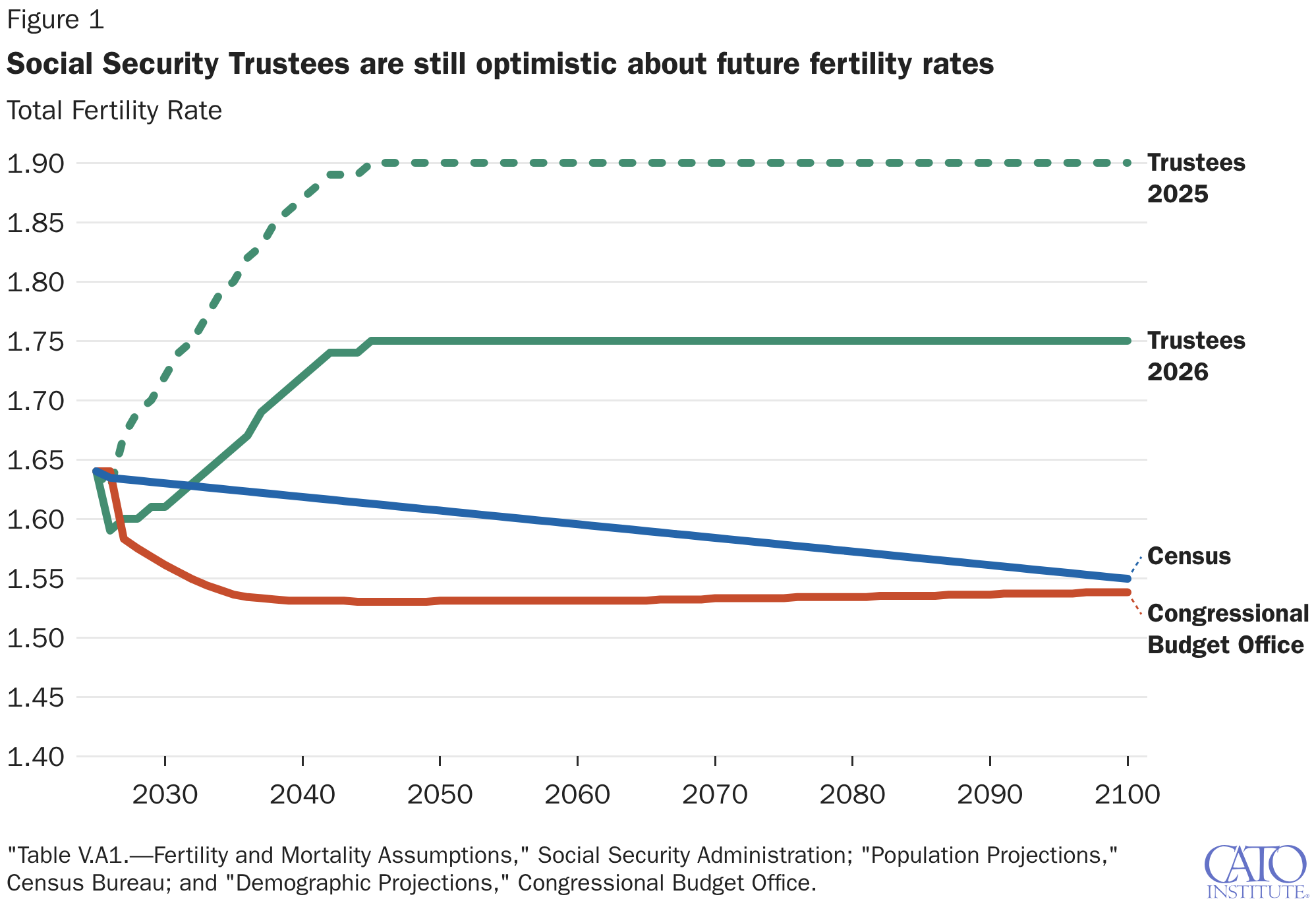
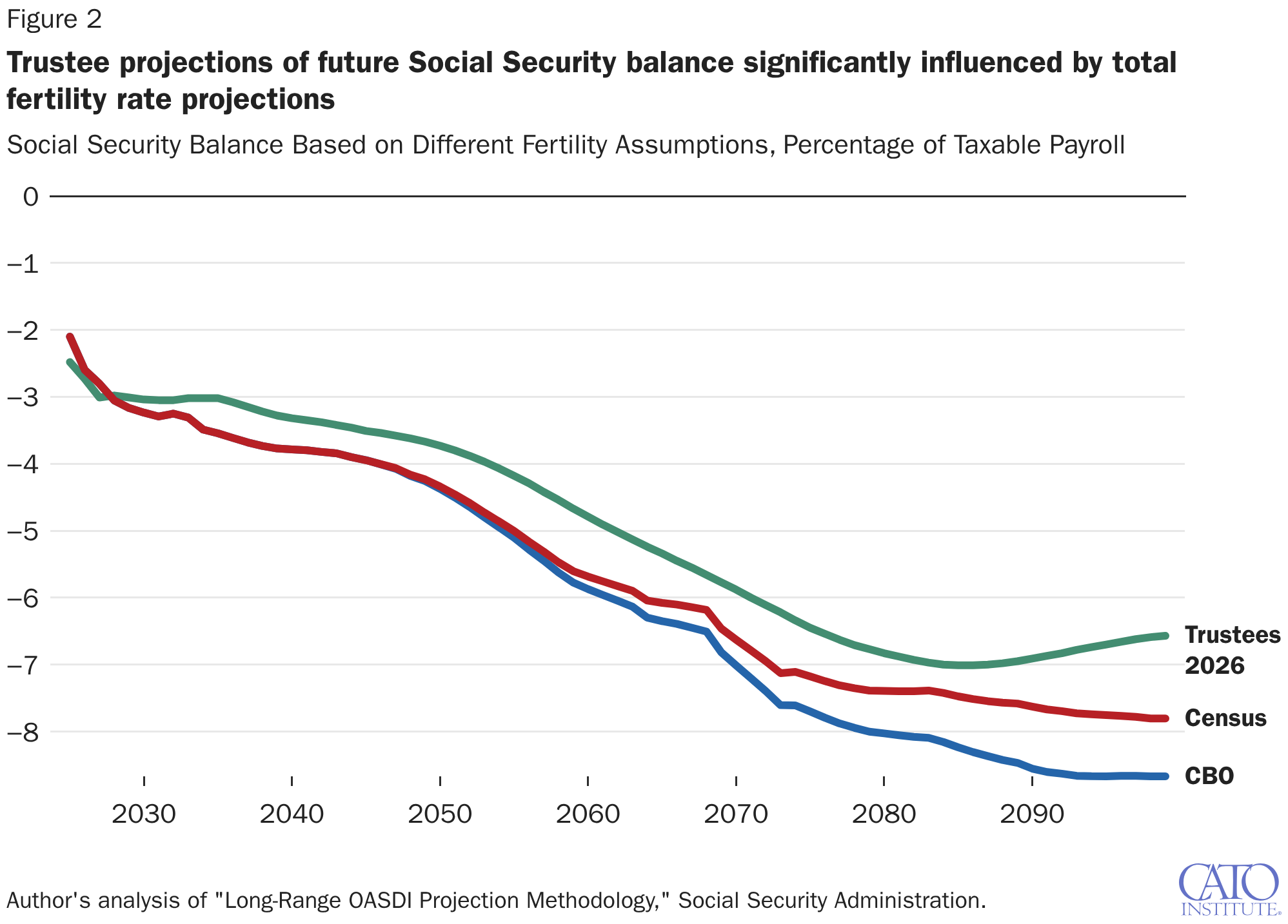
Optimistic fertility assumptions yield optimistic financial projections, as they translate to a larger workforce and, thus, higher revenue estimates. Using the Census Bureau’s or CBO’s fertility projections instead of the Trustees’, the program’s unfunded obligation would rise from $33 trillion to $35 trillion and $36 trillion, respectively. In other words, the Trustees may be underestimating the program’s shortfall by 6–9 percent.
Under more realistic assumptions, over the next 75 years, Social Security’s cash-flow deficits—and therefore its contribution to federal debt—would be higher than shown in the Trustees report. Figure 2 compares the program’s cash-flow balances using lower Census and CBO fertility projections.
Congress Shouldn’t Delay Reform Any Further
Social Security’s spending will far outpace dedicated revenues, regardless of whose fertility projections apply. Meanwhile, Congress has not only procrastinated on addressing the program’s structural funding shortfall but has also recently worsened Social Security’s finances through politically popular benefit expansions and tax preferences.
With Social Security already adding significantly to US deficits, to the tune of $300 billion in 2026 (excluding associated interest costs), the program’s finances are no longer a future problem. While current law won’t force action until 2032, further delay will make the eventual policy changes far more painful. The longer current policy is allowed to go on, the deeper the fiscal hole that we’ll need to dig out of.
Congress has several policy options that would put Social Security on a sustainable path and reduce its fiscal burden, while protecting vulnerable seniors from automatic benefit cuts. Well-designed reforms would also make younger workers better off, whose confidence in the program is already low: only 34 percent of Gen Z currently expect Social Security to exist when they retire. The sooner legislators begin grappling with which combination of changes can close the program’s $33-trillion funding gap and the tradeoffs involved in each option, the better.
Cato’s Social Security Model
To evaluate potential reforms, the Cato Institute has developed the first open-source Social Security model capable of scoring a wide range of policy options. We welcome proposals from researchers, members of Congress, and federal agency staff. A menu of 17 scorable options is available at Cato’s Hub for Social Security Reform. The list is not exhaustive; researchers may inquire about scoring additional ideas by contacting socialsecurity@cato.org.
For researchers with coding experience, the Cato Model is open source and available on GitHub. Researchers interested in accessing the model directly to conduct independent analysis are encouraged to contact socialsecurity@cato.org for further support.
The 2026 Trustees report is yet another reminder that Congress should stop kicking the can down the road on Social Security reform. Whether one accepts the Trustees’ or less optimistic fertility assumptions, the main conclusion is the same: the program is on an unsustainable path, and delay only increases the cost of fixing it. The sooner lawmakers act, the more gradual and targeted reforms can be. Every year of delay narrows policymakers’ options and increases the burden that future workers and retirees will have to bear.
*The authors thank Krit Chanwong for modeling the alternative fertility scenarios presented in this post.
For reform ideas from other countries that have faced similar retirement program challenges, check out our book, Reimagining Social Security: Global Lessons for Retirement Policy Changes.
